Friday, February 12, 2010
Abstract

Project Proposal
It is fairly evident to most that coastal wetlands, specifically in Louisiana, are diminishing, but does this have any practical importance to the public, especially the inhabitants of this area, and nature? I plan to survey the wetlands of Plaquemines Parish by way of canoe, and note the various organisms that depend on this habitat as well as the layout of the land. I will compare the observations of specific locations within the wetlands with personal photographs taken several years earlier to show the degree of erosion that has taken place. In addition, I will use scientific diagrams that show the degree of erosion that has taken place over a 50 year period. I also intend to use scientific journals and personal testimonies to investigate the effects this degradation to Louisiana’s wetlands is causing the public as well as the organisms that depend on this area. I expect to find a large degree of environmental degradation in these areas, due to both anthropogenic and biogenic causes, and the great aesthetic and economic loss of the public that results. The solutions of wetland rehabilitation currently proposed must be investigated for their practicality and usefulness in order to prevent the loss of such a vital ecosystem.
Note: I am not entirely sure that these are the exact methods and techniques I will use for my final project, but I do plan on focusing on Louisiana coastal wetlands.
Final Project Abstract
I am going to be researching eco-spiritualism in the context of indigenous cultures. I will most likely be looking into Amazonian indigenous cultures. As we have discussed in class, there are many ways to go about understanding the environment. We can look at it scientifically, preservationally, conservationally, economically, philosophically, sociologically, etc.. Although there are many different lenses to view environmentalism through, indigenous cultures arguably have a very unique approach to this understanding. Or at least unique to the dominant western worldview. I would also argue that indigenous cultures have a closer and more truthful relationship with nature, seeing as their civilizations depend on the natural world and its processes more so than developed western society. Indigenous cultures seem to be more in touch with the spirituality and natural flow of nature, and I hope to develop a further understanding to that notion rather than just the assumption that I currently hold.
I will research indigenous cultures and their relationships to nature via ritual, mythology, medical practice, and social makeup. I hope to come to an understanding of nature through an indigenous culture’s view. I will contrast that with the understanding of nature from the western world view and hopefully come to a conclusion as to which one is more accurate. I assume I will come to the conclusion that certain aspects will be more accurate, while others more warped.
Project Proposal
Proposal
The purpose of this paper is to investigate the way in which mass media approaches the topic of climate change and thus how it influences the perspective of the public toward this issue. A wide variety of articles and studies related to this subject will be cited in order to observe the extent at which the mass media has or could influence the way climate change is perceived. A section will also be dedicated to data I collect personally from surveys distributed amongst local students. Their responses will also serve to determine whether the media has influenced their standpoint on the issue. Based on personal experience and preliminary research, it is assumed that this investigation will conclude that the media does have an active role in the dissemination of climate change information, and thus the approach it takes will in some way influence the perspective of its audience. Nevertheless, due to lack of information and supporting evidence, it is too soon to determine whether the general approach the media takes towards this topic is positive or negative.
Project Possibility
I plan to begin by looking into the origin of the beef used in the hamburgers and the vegetables used in the veggie burgers and examine the carbon emissions that go into production of each. Then through examining transport, cooking and packaging I hope to gain a sense of the true cost of each item.
Although I expect actual production of the vegetables used in the veggie burger to have fewer emissions than the beef, I know that there are several vegetables in each burger. The separate vegetables are probably grown several locations and therefore emit more during transportation. If this turns out to be true it may prove that, in terms of dining responsibly and reducing carbon emissions, being a vegetarian isn’t always enough.
Thursday, February 11, 2010
Environmental awareness in/through arts, especially music
Are the fine arts able to make aware of environmental issues? Are they powerful enough to change our behavior, to remind us of our responsibility? In this project, I will examine exactly these questions. The main focus is on music, including such songs as “Earth Songs” by Michael Jackson, “The earth is changing” by Depeche Mode and folk songs as well as events such as the “Live Earth”-concerts initiated by Al Gore to raise environmental awareness. Also, I will discuss the relations between music and the sounds of nature and how nature influences music, e.g. Beethoven's symphony No. 6, "Pastoral” or Smetana’s “Vlatva”, to name just two prominent examples. Depending on how far (or not) I can go with these topics, I will also include aspects of Environmental Art and/or Literature.
I expect that the arts will have a certain effect on our awareness but only on a relatively small group of people (compared to the worldwide population) and that the arts alone are not strong enough to create the mandatory change in our behavior to save the environment.
Comment
I am not 100% sure if this will be my final project – but it is the best I can think of at the moment. My problem with this topic is that I indeed want to do something in the field of the humanities (in its broadest sense) but do not intend writing a conventional research paper. However, I do not know how a practical aspect of such a work could look like. Especially since this is a project for Environmental Studies, I have the feeling that my project should be more than “only” a theoretical research paper.
Humans vs. Oceans
Monday, February 8, 2010
Sunday, February 7, 2010
Business within Audubon
As I approach the group of ducks, they would scatter away as if I was an intruder. I settled down on one of the benches and just observed their behavior towards my action. As time progressed they came closer to where I was and my presence no longer bothered them; a pair of ducks passed by in front of me as if I was just another piece that complimented their home. Being an international business major, one of my many tasks will be to modify certain aspects of the business for it to succeed under foreign culture and political views. The “new” business in the foreign country may face disaffection from its potential customers because they are new in the business. If the company is able to adjust to the cultural shock and take measures to create a warm, welcoming environment, their possibility to succeed are very high—just like I was able to take part in the ducks gathering.
One individual always led the “pack” of ducks. However, even though the leader was clearly defined, everything they did was as a team. If one were to fly off to another site, everyone would join in. They held “conferences” as I called them, where they would gather around and just communicate. No one was left out of the group and every individual was “listening” to what they were all saying. In order for a business to properly function, leaders are declared in different sectors and their responsibility is to always look for the well being of the company. A company is a team, every sector and employee must work together in order to succeed; they must all be on the same page. Additionally, they must be responsible and work within the boundaries set by the law and the environment.
Working within the boundaries set by the environment means to not abuse its sources. Several cans and pieces of papers were found on the ground. Its bright colors and silky-look made it clear it was out-of-place. The trash was invading the ducks environment. This is a clear image of how civilization itself is being irresponsible with the environment; the business and its customers must take action and protect their environment. Through outsourcing the businesses have become very oblivious to the damages some of their product has over the land. They are oblivious because they do not witness themselves the consequences of their actions. The ducks are being responsible by only feeding when necessary and the amount of their wastes allow “nature” to make use of it and eliminate it.
Through an artistic perspective, the colors of the surroundings set the mood of everything. The cloudy sky darkens the picture. Shades of dark brown and green blend in with the colors of the ducks feathers. The weather is cold and windy; the presence of winter still inhabits New Orleans. The mood of all the creatures living in the park is quiet and relaxed—very different as to how it would be if it were sunny and warm. No signs of warm and happy colors around, only of those “out-of-place” objects invading the home of those living in the park. Everything is connected and related, as how it all should be. We should all be able to fit in with our environment and coexist with the many religions, race, and political views—just like the many different species of ducks and birds are able to live in harmony.


Audubon Park Adventures
Another lens through which I involuntarily looked was that which took note of all the trash lying around. This somewhat led into my next area of focus, which was what I guess I'll call a historical one. I took note (mostly through photographs) of evidence of change, be it natural or human-induced. Sometimes the distinction was difficult to make, as in the case of branches broken off of trees. Some of the things I recorded were quite obvious, such as the existence of park benches, trash cans, and the worn (not paved) path that winds along the lagoon's edge, while others were more subtle, like the presence of what looked like a brick or small cement slab embedded in the ground, and pebble-like chunks of tar or brick mixed in with the dirt, rocks, and shells in certain areas. What this brought up to me were what the motivations were for the changes. Some were again obvious, i.e., the trash cans were present to discourage littering, while others raised unanswered questions, such as the stump of an obviously considerably sized tree near the water's edge. I also knew from previous classes that certain clues visible in the park meant that more change was coming shortly. For example, the lagoon was quite full with leaves and other debris. For the first few feet or so, the depth didn't appear to exceed six inches. This means that relatively soon, the lagoon will be dredged so that it will remain intact. Some more overhanging branches may also be trimmed to decrease the rate at which leaves pile up within.
Nature.
Field Observations in Audon Park
Journalistic vs. Ecological
The moment I entered Audubon Park I analyzed my surroundings through a journalistic/photographic lens. The picturesque background seemed as if it belonged in a magazine and so I attempted to capture every moving creature in a photograph. I watched as the ducks created a rippling effect as they waded through the water and as the tree branches gently swayed over the lagoon. Through a photographic perspective, the park is rich in vegetation and the interaction between the wildlife (i.e. birds, ducks, squirrels) and plants was beautiful. In relation to journalism, I began by considering the purpose of the park and whether or not it fit the needs of it's visitors. Out of curiosity I asked two Loyola students that visit the park regularly. Although they both said that it was "beautiful" and has "something for everyone", like a golf course and park for children, it would be nice if it had more recreational areas like tennis and volleyball courts. I also began to think about the park's peak hours and when it is safest to walk. Based on experience, I concluded that it is most full between 3-5pm. After some brief research, I discovered that criminal acts, such as rape, have taken place at Audubon Park. For this reason visitors -- especially those in small groups -- should visit during peak hours.
Through the perspective of a biologist, I analyzed the park in a completely different way. I first began by observing the diversity of the bird species, and quickly noticed how they were all so different. From merely strolling beside the front lake, I saw approximately six different kinds of birds (mallard, swan, crane, etc.). I then began to consider the close proximity the park has with urban life, and whether it affects the well being of the wildlife at all. I noticed a significant amount of litter around the park benches and I couldn't help but wonder how the presence of joggers, restless children, and even horseback riders impacts the natural habitat.
Interconnected
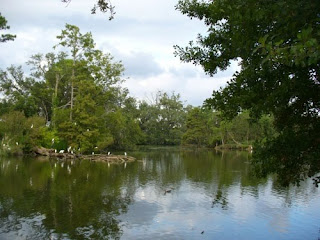 on, actually likes to note the interconnected web of life that is earth. This was a helpful exercise to learn how to view the environment around us trough different eyes.
Ducks and Golf
Wordsworth and Audubon Park

During my field study of Audubon Park (which mainly included observing different tree species e.g., Weeping Willows and Cypresses and noting their crown uniformity and foliage), William Wordsworth's poem "Lines Written in Early Spring" quickly came to mind despite the winter season. Published in Lyrical Ballads (1798), this poem offers a penetrating study on humanity and our environment. For my post, I'll give a rather lengthy explication of the poem.
Lines Written in Early Spring
I heard a thousand blended notes,
While in a grove I sate reclined,
In that sweet mood when pleasant thoughts
Bring sad thoughts to the mind.
To her fair works did Nature link
The human soul that through me ran;
And much it grieved my heart to think
What man has made of man.
Through primrose tufts, in that green bower,
The periwinkle trailed its wreaths;
And 'tis my faith that every flower
Enjoys the air it breathes.
The birds around me hopped and played
Their thoughts I cannot measure:--
But the least motion which they made
It seemed a thrill of pleasure.
The budding twigs spread out their fan,
To catch the breezy air;
And I must think, do all I can,
That there was pleasure there.
If this belief from heaven be sent,
If such be Nature's holy plan,
Have I not reason to lament
What man has made of man?
I generally tend to scoff at the standard interpretation of “Lines Written in Early Spring”—that is, another poor anti-industrial, Romantic laments on humanity’s detachment from nature. When the line “what man has made of man” is uttered, the mind, in Pavlovian fashion, automatically thinks pollution, deforestation, chemical spills, and ceaseless technological change. This interpretation is suffocatingly simplistic. First and foremost, humanity is intricately a part of nature, whether we like it or not, and any petty attempt at escapism is woefully ignorant. Recent biology strengthens my point. At the microcosmic level, we are composed of mitochondria, which have their own DNA and RNA quite different from our own. Without them, we would not move a muscle or think a thought. Rarely mentioned, our centrioles and basal bodies, along with other similar tiny creatures work in our cells each equipped with their own genomes. Even further, our cells are ecosystems more complex than the Greater Antilles. As moderns, we must acknowledge that we can never detach ourselves from nature materially, no matter the polymer, glass, and steel we enclose ourselves in; however, spiritual detachment is possible.
Nature's and humanity’s existence vastly differ in “Lines Written in Early.” To begin with, nature merely exists. It’s unemotional, non-judgmental, and unthinking. It just is. To the human eye, nature is organically beautiful and content in this ontological state. In typical Thel fashion, nature is content because it has a purpose. In the poem, inside a grove, the speaker observes what nature has to offer from “primrose tufts” and “periwinkles” to “budding twigs.” Imposing an aesthetic, he finds these natural elements beautiful and pleasant. However, a crucial turn surfaces when “in that sweet mood” “pleasant thoughts bring sad thoughts to the mind.” In other words, the act of thinking elicits depression and psychological discomfort within the speaker, for human thought is corrupt, which is a point William Blake would emphatically make. Throughout the poem, the speaker arduously anthropomorphizes nature as blissful and highly pleasured. This isn’t surprising since humans have an unwavering talent for anthropomorphizing and an insatiable appetite for pathetic fallacy. Arguably, I don’t think Wordsworth advocates this talent: in his view, humans shouldn’t anthropomorphize nature; nature should anthropomorphize us. Pathetic fallacy is malicious ivy. It permeates our ontological philosophy. Throughout the centuries, humanity has asked their ontological environment about the nature of existence, being, and reality, always beginning with that petulant, relentless interrogative word “why.” We attempt to give our environment the human characteristic of thinking and speaking, so it can answer us. Wordsworth wants us to discover a way other than cognition to link to nature.
In this poem, pathetic fallacy is the poetic fulcrum. In lines 19-20, the speaker is doing all he can to convince himself that nature is sanguine in its state—it’s a yearning so strong and so insistent that it cannot be effectually resisted. As a Romantic, he envies this ontological state, for nature doesn’t delve into horrid grief when someone dies, and nature doesn’t suffer from existential anxiety when it contemplates the strangeness and irrationally of reality. Assuming this is so, we shouldn’t be a part of nature—we should be nature. With human hearts beating to this idealistic idea, we must escape our imperfect, besmirched, seedy, and spurious mammalian nature. It’s important to note that nature isn’t this cold, robotic entity. The Swiss Alps, the ornate lion fish, or very tightly furled buds beginning to burgeon and unfold do not convey this image. More to the point, it seems as though the natural world does not react to destruction with human hysteria. Rather, it embraces destruction and flawlessly realizes that destruction is a part of creation without even thinking, similar to life and death. Since we are at the mercy of our limited senses, humans have trouble viewing life and death as existence itself. Ultimately, “Lines Written in Early Spring” is a grab at transcendence, transcending this feeble state of mind--so we can just be.
The other side of the spectrum was much more pleasant when I started noticing it. Rather than focusing on the effect of humans on this environment, I saw the effect of this environment on humans. Everyone I saw in the park looked happy: the construction workers, the people riding on horses, the man who was painting, the joggers, and even I felt happier being outside. It was a pretty bleak day; the sun wasn’t out and it looked ready to rain. But I still enjoyed watching the ducks and sitting under a gigantic oak tree. It is odd that even in cold weather, with a bad cough and a runny nose, I just felt happy to be outside. Even if it is a manmade imitation of nature, Audubon park is still pleasant because it is the closest piece of “nature” that I am comfortable with.
The second view I saw the park in was a religious lens. I thought about the piece we read by St. Fancis of Assisi, and how some refer to him as one of the first environmentalist. Religious beliefs are important because it effect how we view and interact with the environment. In most monotheistic religions people view themselves as stewards of the earth. For example Christians believe that God gave us the earth and we can do what we want with it, but we are also responsible for taking care of it. In many ways New Orleans is strong influenced by Catholicism. And looking at the park I could see some of the stewardship thinking. We are responsible to set aside park space, but we still can build walking paths and fountains. The park is still very beautiful and nice, but I thought about how different it would be if we lived in a society that was primarily influenced by Wicca, Hinduism, or Buddhism. Our park would probably be much different.
Audubon observation
Now let us take the park from an Environmental stand point. There is much to be done to restore and preserve this small treasure in the middle of a bustling city. There is trash thrown here and there but I can say that the littering is far less here than in many other places. The pond in Audubon is a bit of a disaster. In my Environment and Society class I learned that they actually install filters within the pond to provide oxygen but the run- off from the gulf course clogs them, resulting in a number of fish dying at once. It is only after this happens that the problem is acknowledged.